A Damocles Sword Over the Roof of the World
Building in a seismic zone, silencing the aftermath: China's choices in a climate emergency
Executive Summary
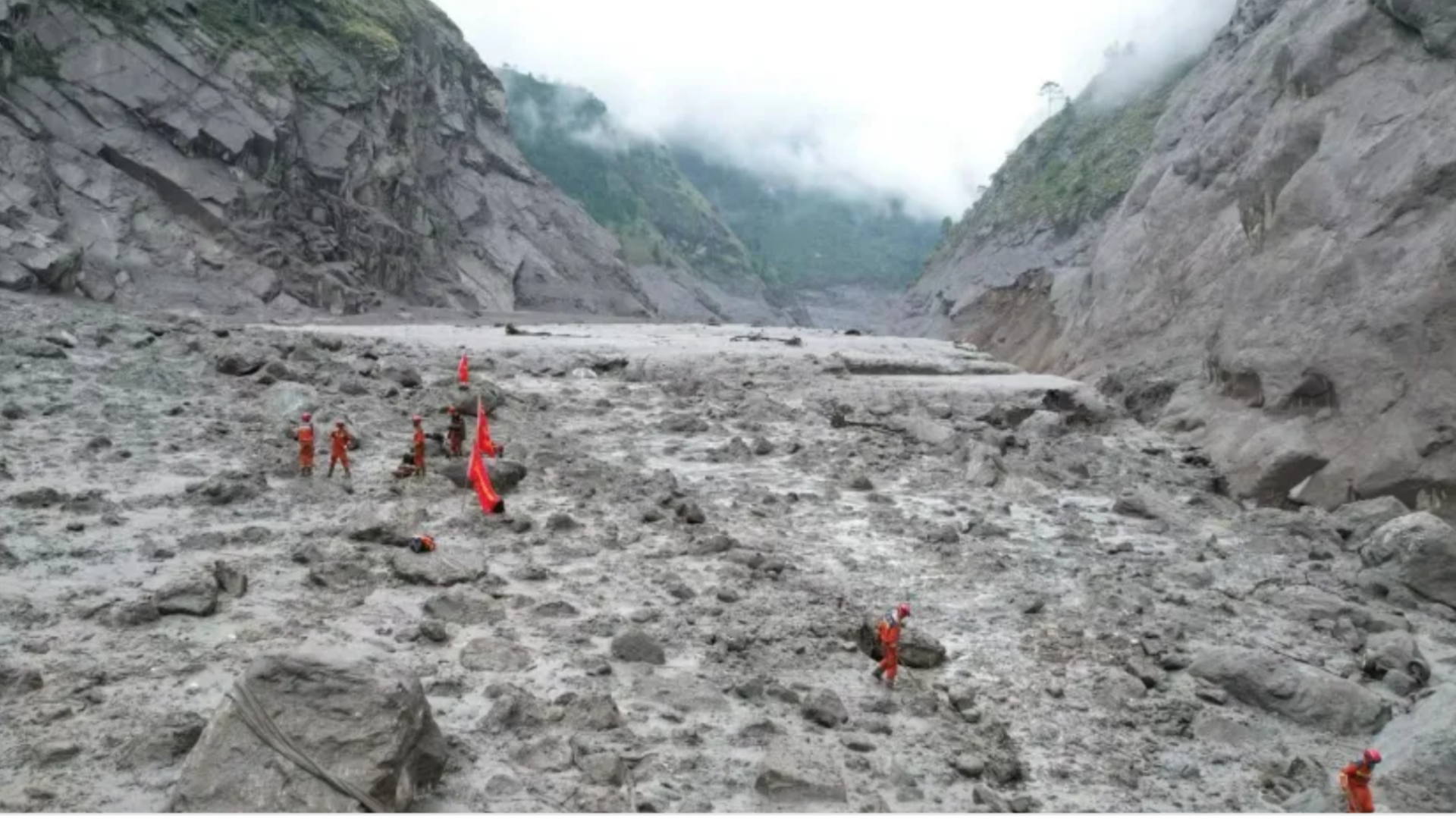
Nearly four weeks after a devastating flood of water, ice, rock and sediment swept down the valley at Kyirong on the border of Tibet and Nepal, a catastrophic loss of life has been compounded by a climate of fear as Chinese authorities threaten reprisals for anyone expressing views that may differ from those of the Party state. One netizen was penalised after they gave a higher figure for those missing than the official line and said that the disaster was “heartbreaking”.
The image that will outlast the Kyirong catastrophe is of the port’s immigration building being swept away in seconds as people fled on the morning of 26 August. Border ports are routinely described as places of transit and bridges between nations. For Tibetans this one was neither: a crossing effectively closed to them in both directions, sealing a frontier that for centuries was no barrier at all.
In the sequencing of official statements following the disaster, China’s propaganda narrative effectively placed responsibility across the border and on an abstract ‘climate’, leaving no room for the questions that fall within the state’s own responsibility: why the port was built where it was, what hazard assessments preceded it, and what warning was possible.
What was erased at Kyirong was one of the main land crossings Tibetans had left to Nepal after Dram – once the main exit point for Tibetan refugees escaping into exile – was rebuilt as a military garrison town with most residents relocated after the 2015 earthquake.[1] For centuries Kyirong was a trade corridor as much as a pilgrimage route. Caravans carried salt, wool and yak products down to the Nepali valleys as winter came, and brought grain and other goods back up. The decades-long sealing of this border cut that exchange.
Heightening the risks of catastrophe – and despite warning signs including a similar flood a year ago in July 2025 that swept away the bridge – extensive trade, pilgrimage, and tourism traffic have since been funnelled into one heavily securitised Himalayan valley.
On 16 September an international team from World Weather Attribution concluded that decades of warming set the stage for the ice-rock collapse that caused the floods. The glacier had thinned and shrunk over recent decades, particularly since 2010; the freezing line has risen by around 100 metres a decade; and July and August, the hottest on record locally this year, are now around 1.5°C warmer than they would be without climate change. Beijing has invoked the climate as a cause beyond its control. But China is the world’s largest emitter of greenhouse gases, and so the largest contributor to the heating now destabilising Himalayan ice.
What remains in question is what the Chinese state did with a risk that was foreseeable and partly of its own making. It is building dams, roads and tunnels at speed across the most seismically active mountains on earth, over India’s objections and against the warnings of its own geologists. It does this in a region where fewer than two dozen of tens of thousands of glaciers are monitored on the ground,[2] and which is closed to independent research.
After a carefully choreographed and selective foreign press trip was allowed in on 6 September, the story on Chinese state media shifted to reports that 444 of 499 evacuated villagers have gone home, while saying nothing about how many villages the flood struck, or how many people were killed in them. In one of the most heavily securitised regions on earth, the state’s own narrative is the only one that is safe to repeat.
Beijing’s control of information does not stop at Tibet’s borders: three months before the disaster, Nepal met Chinese officials in Kathmandu seeking closer cooperation on glacier hazards and water data, and came away without an agreement.[3] In a climate emergency, independent environmental assessment, hazard monitoring and cross-border information-sharing are not diplomatic courtesies but basic infrastructure for the hundreds of millions who live downstream of the plateau.
For Tibetan families the cost of that is not only grief but a religious crisis. Buddhist practice requires the body of the dead to be protected and prayers and rites performed over it in the days after death to secure an auspicious rebirth – an obligation Tibetans have taken extraordinary risks to meet. Since a wave of self-immolations in Tibet from 2009 onwards, many Tibetans have endangered themselves by seeking to retrieve the remains of those who set themselves on fire from Chinese police. Across the border in Nepal, while some families objected that temporary burial of those who died in the August floods disregarded Hindu rites, others performed funerals using kusha-grass effigies in place of bodies. In Tibet none of this is possible.