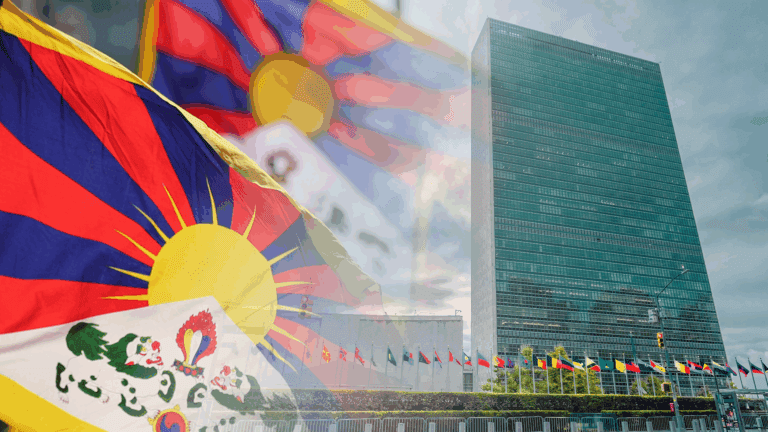
David Milliband urged to make public statement on Tibet in China
Free Tibet: UK must make amends for 2008 blunder recognising direct Chinese rule over Tibet
Free Tibet has urged British Foreign Secretary, David Miliband, to make
"a public statement on Tibet and the British government's concern for
the human rights crisis there", during his trip to China next week.
In a briefing paper sent to Mr Miliband this week, Free Tibet emphasised
the "sensitive timing" of his visit which coincides with an intensified
security crackdown inside Tibet, announced by the Chinese authorities at
the beginning of March and which will continue throughout the visit (1).
The Foreign Secretary's trip also falls at the time of an especially
sensitive series of anniversaries in the Tibetan calendar.
Speaking in advance of next week's trip to China by the Foreign
Secretary, Free Tibet Director, Stephanie Brigden, said:
"Failure to make a public statement on Tibet will only be interpreted as
tacit support for China's ever more repressive regime inside Tibet. Not
only would it hand China a wholly undeserved propaganda victory and
embolden the Chinese authorities to carry on perpetrating further
atrocities, but it would also cast strong doubt on the British
government's professed claim that human rights are integral to its
strategy for engagement with China."
Tibet will also be looming large over Mr Miliband's trip as it will be
his first to China since he made a highly controversial statement on
Tibet in 2008. For 94 years Britain had been careful not to officially
recognise Chinese sovereignty in Tibet, preferring instead merely to
recognise China's "special interest" there. But in a statement (2)
issued on October 29 2008 immediately after his return from his last
visit to China, Mr Miliband announced that henceforth Britain would
regard Tibet "as part of the People's Republic of China".
This major change to British policy was made without parliamentary
scrutiny and was cited as a victory by Chinese officials to envoys of
the Dalai Lama in early November 2008 shortly before China confidently
announced that the Sino-Tibetan Dialogue had failed and that China would
"never" accept calls for Tibetan autonomy. The Sino-Tibetan Dialogue was
recently resumed when the Dalai Lama's envoys travelled to Beijing in
January. But remarks made by the Chinese lead negotiator, Zhu Weiqun,
that the sides remain "sharply divided" and that there was no
possibility of the "slightest compromise" over Tibetan calls for
autonomy (3) indicate continuing Chinese intransigence over substantive
dialogue.
In December 2008 Mr Miliband attempted to justify the diplomatic blunder
to the Foreign Affairs Select Committee (4) by arguing that that the
change had been made "because we thought it was in the interests of our
own country and its ability to forge, or argue for, human rights in
Tibet and good relations with China."
But sixteen months later there is little evidence to suggest that, by
offering up such a prized concession to China, Britain has enhanced its
ability to promote human rights in Tibet. In October 2009 China executed
two Tibetans, ignoring a request made just weeks earlier by a British
Foreign Office Minister on a trip to Tibet for the executions not to go
ahead. And the ineffectiveness of British strategies for promoting human
rights in China and Tibet was made clear when China publicly and angrily
cancelled at very short notice a human rights dialogue with Britain
after Britain protested at the execution last December of the British
citizen, Akmal Shaikh, in China. The government's failure to obtain a
human rights dividend from offering up the concession on Tibet was
acknowledged by Parliament's Foreign Affairs Select Committee which
stated in August 2009:
"We conclude that there remains little evidence that the British
Government's policy of constructive dialogue with China has led to any
significant improvements in the human rights situation." (5)
Commenting further on the Foreign Secretary's visit to China, Free Tibet
Director, Stephanie Brigden, added:
"Following his last visit to China the Foreign Secretary sacrificed the
status of Tibet. On this return trip, therefore, he must make amends by
securing some real, and positive change for the Tibetan people. A
strong public statement during his visit, calling on the international
community to insist that China takes a substantive and
results-orientated approach to dialogue on Tibet would be a good place
to start."
Ends
For further information:
Matt Whitticase, External Communications
t +44 (0)20 7324 4605 / +44 (0)7515 788456 and email: matt@freetibet.org
Stephanie Brigden, Director
t +44 (0)20 7324 4605 / +44 (0)7530 528264 and email:
stephanie@freetibet.org
Notes to Editor:
(1) In an article yesterday, the New York Times cited a Xinhua report
which quoted the deputy chief of the Lhasa police force, Ma Jun, as
saying that a "crackdown storm" had been launched on March 2. AFP cited
a Xinhua report that 1,500 extra security officials had been deployed in
Lhasa. The Xinhua report quoted a statement made by Tibet's deputy
Communist Party leader, Zhang Yixiong:
"We must clear our eyes, clench our fists, grip our weapons and firmly
prevent and severely strike at every separatist or destructive activity
that harms national security and social stability".
The Times newspaper reported that the state-run Lhasa television channel
had announced in recent days a new "strike-hard" campaign in Lhasa aimed
at targeting "criminals" but also those lacking papers permitting them
to travel into Lhasa. According to the Times, which has spoken to
residents of Lhasa, additional police controls in Lhasa have been
requiring all Tibetans to produce temporary residence permits as well as
letters of introduction allowing them to be in Lhasa while Han Chinese
were not being stopped. The Times also reported that existing police
patrols in Lhasa had been expanded this week to include convoys of
trucks, processing slowly through Lhasa's streets, full of armed and
uniformed paramilitary forces. One convoy was reported to total 14
trucks.
On Wednesday the Dalai Lama showed his deep frustration with the ongoing
repression in Tibet of the Chinese authorities who, he said, were
"putting the monks and nuns in prison-like conditions". The Dalai Lama
emphasised that such conditions imposed by the Chinese authorities "are
intended to deliberately annihilate Buddhism in Tibet".
Mr Miliband's arrival in China next week also falls around the time of
two hugely sensitive Tibetan anniversaries: the 51st anniversary of the
1959 Tibetan National Uprising in which more than 80,000 Tibetans were
killed by Chinese troops; and the 2nd anniversary of the 2008 uprising
in which Tibetans demonstrated their deep-rooted and widespread
opposition to Chinese rule in protests that swept across the Tibetan
Plateau.
The AFP article is available at:
http://www.google.com/hostednews/afp/article/ALeqM5hFCnhVt-j73LGL3iFkG7b
4I3eDHw
The New York Times article is available at:
http://www.nytimes.com/2010/03/12/world/asia/12tibet.html
The Times article is available at:
http://www.timesonline.co.uk/tol/news/world/asia/article7056345.ece
(2) The Written Ministerial Statement, issued by Mr Miliband on 29
October 2008 - together with Free Tibet's press release in reaction to
the statement, is available at:
http://www.freetibet.org/newsmedia/060508
(3) Mr Zhu's comments were reported by the BBC in an online article
which is available at: http://news.bbc.co.uk/1/hi/8492608.stm
(4) The full transcript of the session is available at:
http://www.publications.parliament.uk/pa/cm200809/cmselect/cmfaff/79/812
1005.htm
(5) The FASC's comments were made in its Human Rights annual Report for
2008, published in August 2009, and which is available at:
http://www.parliament.uk/documents/upload/FACpn36090809.pdf